How Can We Be Salt?
Solidarity in action: Now is the time.

I’m always down for a good metaphor, and the one that’s been brought to me more than once in the past few weeks is that salt melts ICE. The winter storm that’s affecting more than half the country this week has made this metaphor even more apparent.
In a recent sermon, Rev. Otis Moss III reminded me of the dual purpose of salt: Salt melts ice; it’s what breaks down solid to liquid and prevents us from slipping. But it’s also a balm—a healing agent that soothes wounds and preserves what matters.
This is the work of solidarity.
We must be salt for the people—offering comfort, support, and healing to those bearing the brunt of violence and oppression. And we must also be salt on the ice—actively working to melt the systems that perpetuate injustice.
We’re living in a time when state-sanctioned violence continues to devastate communities across our country. Violence against Black and Native communities is woven into the formation and growth of this nation, so this is nothing new… but it’s certainly heightened at this moment in time.
Last week we saw Renee Good and Alex Pretti pay the ultimate price when they were killed by federal agents as they stood, unarmed, in support of those in resistance. We also saw individual people and communities rise up in solidarity to support and grieve with their families. And we saw people continue their protests of ICE presence and tactics in Minnesota and across the country.
For those of us committed to justice, the question has never been whether to act but how.
What Solidarity Looks Like
As the brilliant folks at the Building Movement Project have been saying for years, solidarity is action and we can all have a role within it.
In Justice at Work, I talk about how, by using our gifts and resources, we can engage in solidarity work on personal, interpersonal, cultural, and institutional levels. The different ways salt operates brings to mind the different options we have to show up.
This is what solidarity can look like:
Supporting people and communities in resistance means showing up when it matters. In Justice at Work, I talk about Peter Norman, the Australian runner who stood on that Olympic podium in 1968, alongside Tommie Smith and John Carlos, as they made the Black Power salute. Norman lent Smith and Carlos his gloves and wore the Olympic Project for Human Rights badge in solidarity. And for this choice, Australia never let him compete internationally again. Solidarity can come with a cost.
Today, this looks like supporting organizers working to end state violence, standing with undocumented community members facing abduction and deportation, amplifying the voices of those in resistance, and following the lead of organizers on the ground. This looks like Renee Good peacefully protesting ICE within her neighborhood and Alex Pretti helping a fellow protestor from the ground.
It means using whatever platform, resources, or access we have to support those being targeted.
Interrupting bias requires us to look inward. We can’t be salt for anyone else if we don’t attend to our own conditioning and to that of those closest to us. This means challenging our implicit and explicit biases, holding ourselves accountable for our own actions, and being willing to interrupt harmful words and actions when we see it in others—even when it’s uncomfortable (especially when it’s uncomfortable). As Brene Brown implores, we must ‘choose courage over comfort.’
Education is ongoing. Understanding the history of oppression in this country, learning current frameworks and language, staying informed about what’s happening right now—this is foundational work. We need a stronger analysis of the problems we face, and we need to understand how we got here. Salt preserves, and part of our work is preserving and learning from the history of resistance that came before us. (I recommend following the Anti-Authoritarian Playbook for analysis framed by history and punctuated with strategic advice.)
Cultural shifts change the everyday environment we’re living in. This is about the unwritten rules, the visual landscape, the habits and norms that shape our shared spaces. When a public library in a conservative area has a Black Lives Matter display all year round, when a community votes to remove monuments honoring white supremacists, when institutions provide all-gender restrooms—these acts reshape our culture to be more inclusive rather than marginalize. They signal whose dignity matters, who belongs, and who is safe. We also shift culture when we make noise for others.
Institutional advocacy means changing formal structures—laws, policies, and practices. The Pre-Trial Fairness Act which eliminated money bond in Chicago’s jail system, didn’t pass itself. It required grassroots organizing, community pressure, and people in positions of power choosing to do the right thing. This is salt melting ice—breaking down the legal barriers that codify injustice. This is the work of the Rising Majority.
Systems change is the deepest work: dismantling oppressive systems entirely and building something new from the ground up. This means reimagining public safety without policing and prisons. It means creating healthcare systems where everyone is cared for regardless of class. It can be hard to envision because we’ve been so conditioned by what exists, but communities are already doing this work—and already proving that another way is possible.
The Time is Now
When we rub salt on the body, we invigorate healing. When we put salt on the ice of our streets, steps, and sidewalks, we make it easier and safer for people to move freely. At this moment in our country’s history, with state-sanctioned violence targeting the most vulnerable among us, we cannot afford to be bystanders.
The question for each of us—individually and collectively—is simple: How can we be salt?
Our workplaces, our schools, our organizations, our neighborhoods—these are all sites where we have the opportunity to act. We can provide protection for people being targeted. We can support the families left behind by the disappeared. We can feed our neighbors. We can run errands for friends who are ill. We can show up on the streets. We can mobilize our faith communities. We can call our representatives.
We can be salt, melting hardened systems shaped by laws and policies that have stripped our rights. We can be the ones who help each other brave this storm.
Yes, solidarity asks something of us: It asks us to risk comfort, to share resources, to use our power to bring power to those being denied it. It asks us to show up, to speak up, to act.
Because ICE will not melt on its own, and our wounds won’t heal without care. But together, acting in solidarity, I’m hopeful that we can be the salt this moment requires.
Towards shared power,

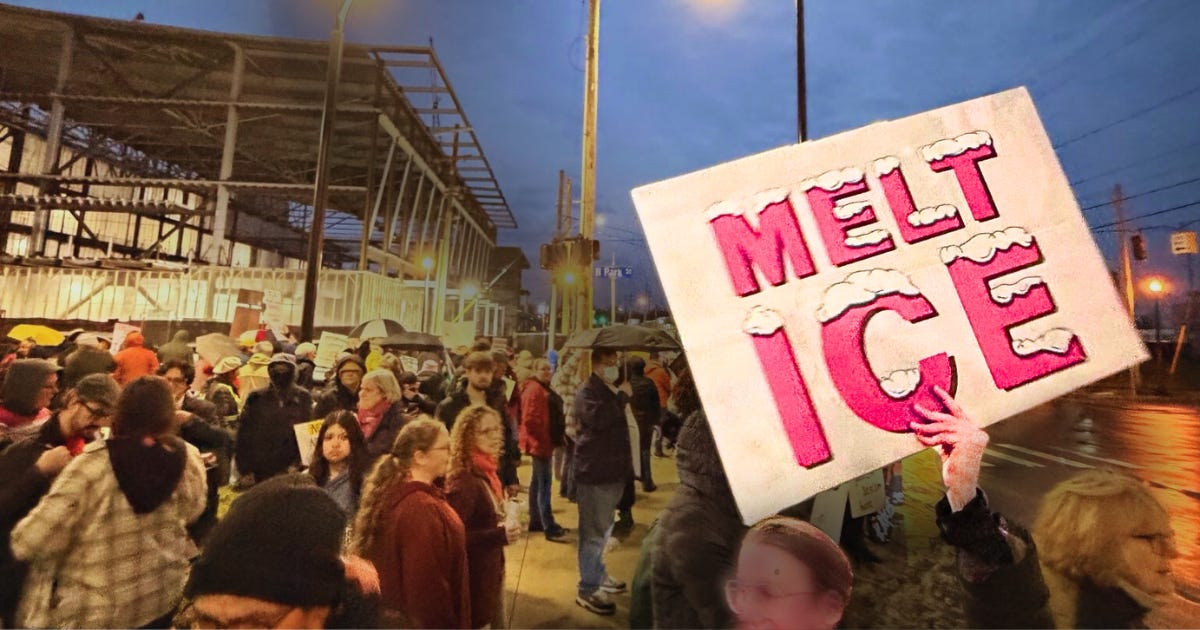
PPS - In case you want to use the Kalamazoo protestor’s sign, you can pull the image below.